Contractors: Prevent Dissimilar Metals Corrosion With the 10:1 Area Ratio
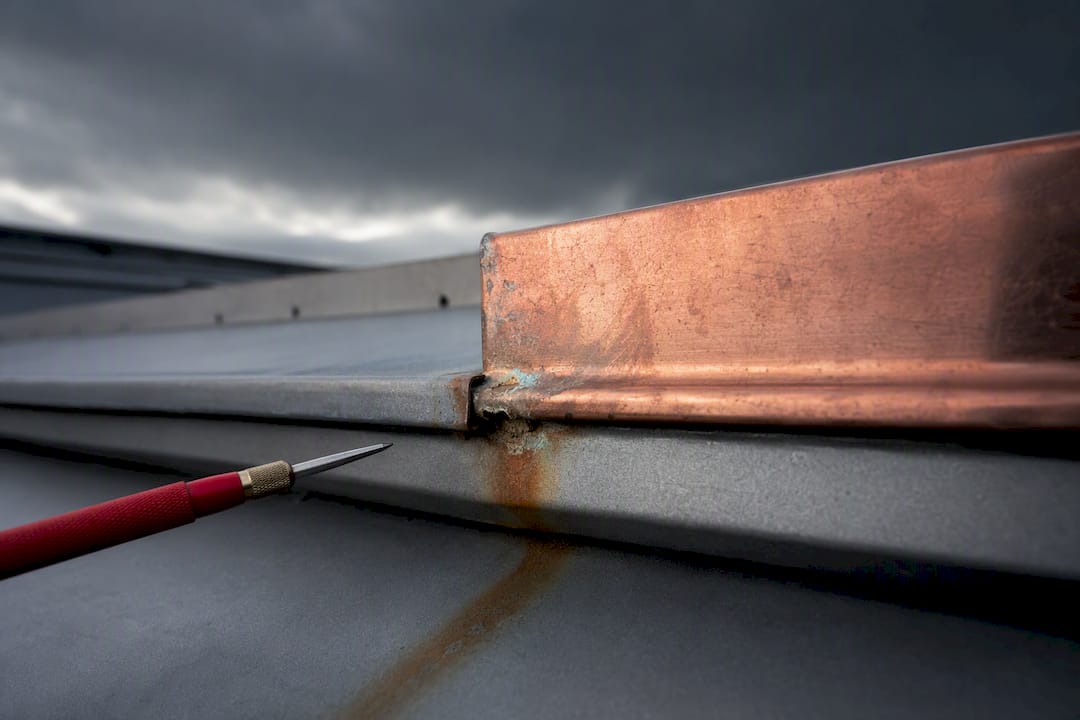
Contractors: learn why electrochemical action turns small fasteners into failure points, why the 10:1 area ratio and 200 mV threshold matter, and...
Dissimilar metals corrosion, better known as galvanic corrosion, happens when two different metals are electrically connected and bridged by an electrolyte. The less noble metal becomes the anode and corrodes faster than it would alone. Worry most when a small fastener or clip of one metal touches a large panel of another in a wet, salty, or humid environment. That combination of area mismatch and moisture is what turns a theoretical incompatibility into a field failure.
TL;DR:
- Using dissimilar metals in environments with high humidity or salt exposure significantly increases corrosion risk, especially if area ratios and coatings are not properly managed.
- Fasteners are the most vulnerable points for galvanic corrosion on structures, especially when a small anodic fastener contacts a large metallic surface in wet conditions.
- Metal pairs with potential differences below 200 millivolts can still corrode aggressively in marine or industrial environments, requiring project-specific testing.
- Proper material selection, deliberate area ratios, electrical isolation, and sealing are key measures to prevent galvanic corrosion in construction assemblies.
- Regular inspections and monitoring, especially after storms or in coastal areas, are essential to catch active corrosion early and prevent structural failures.
Table of Contents
- What Causes Dissimilar Metals Corrosion at the Electrochemical Level?
- Which Environmental and Geometric Factors Change the Risk?
- Where Does Galvanic Corrosion Actually Show Up on a Job Site?
- What Do the Standards Actually Require for Compatibility?
- How Do You Actually Prevent Corrosion Between Different Metals?
- How Should You Inspect for and Monitor Galvanic Damage?
- Applying This to Standing Seam Roof Assemblies
- Three Rules That Keep Galvanic Surprises off Your Punch List
- Sources
What Causes Dissimilar Metals Corrosion at the Electrochemical Level?
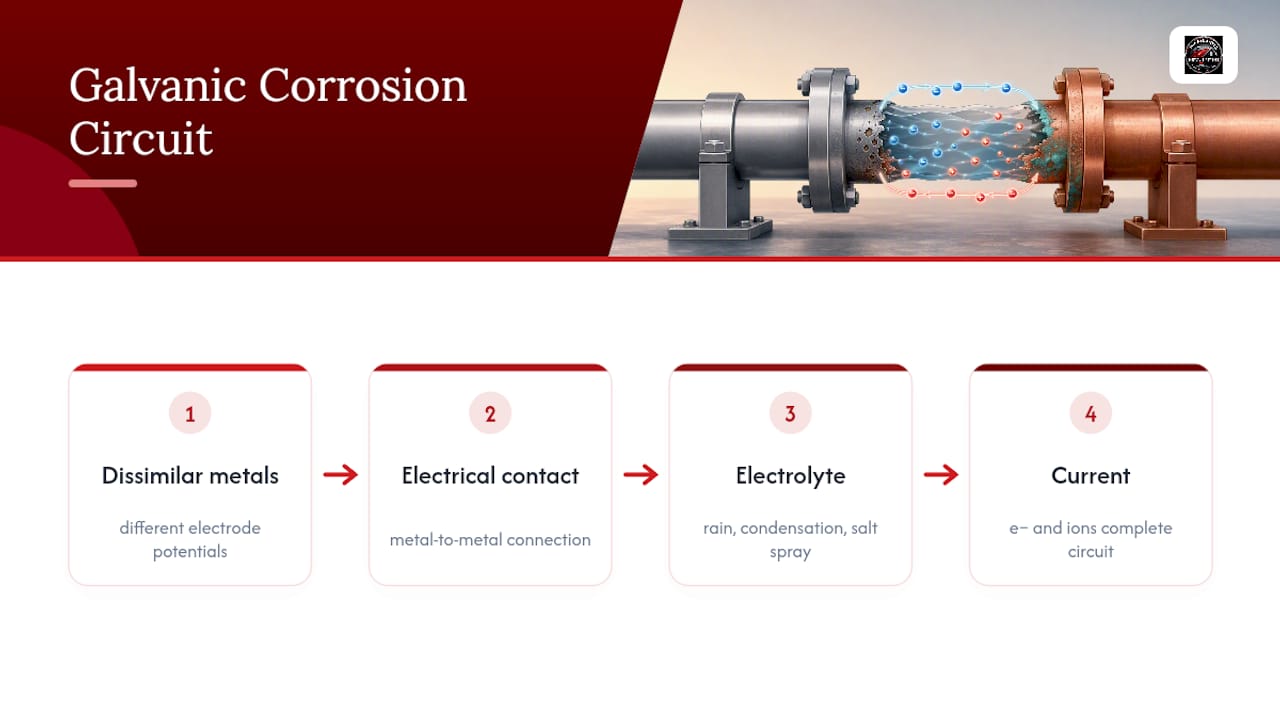
Every galvanic couple needs three things: two metals with different electrode potentials, a physical electrical connection, and an electrolyte to carry ions between them. Rainwater, condensation, salt spray, even a persistent film of humidity, all qualify. Once that circuit closes, electrons flow from the anodic metal to the cathodic metal through the metallic contact, while ions move through the electrolyte to complete the loop. At the cathode, oxygen or hydrogen ions get reduced. At the anode, metal atoms give up electrons and dissolve into the electrolyte as ions. That dissolution is the corrosion you eventually see as pitting, staining, or metal loss.
The galvanic series ranks metals by their relative nobility in a given electrolyte, and it’s a useful starting point. But treat it as a guideline, not gospel. The ranking shifts with chloride content, dissolved oxygen, flow rate, and temperature. A metal that sits comfortably mid-series in freshwater can behave very differently in a coastal spray zone. ASTM G82 exists specifically because engineers on demanding projects sometimes need a project-specific series rather than a generic chart.
Potential difference alone doesn’t tell you how fast a couple will corrode. Two metals can sit far apart on the galvanic series yet corrode slowly if one of them forms a passive oxide layer that polarizes quickly and chokes off current. Others sit close together on paper but corrode aggressively because of how their surfaces behave once wetted. This is why kinetics, meaning how each metal’s surface reactions actually proceed under load, matters as much as the raw voltage gap.
Which Environmental and Geometric Factors Change the Risk?
The same metal pairing can be harmless in one detail and destructive in another, and the difference almost always comes down to a handful of measurable variables.
- Electrolyte conductivity: Deicing salts and coastal chloride exposure dramatically increase conductivity, which increases current flow between the anode and cathode.
- Surface wetting and humidity: A thin conductive film can form on metal surfaces at high relative humidity, and chloride contamination can trigger that same wetting at lower humidity levels than clean environments would require.
- Area ratio: A cathode-to-anode surface area ratio of at least 10:1 is the standard mitigation heuristic, because concentrating a fixed current over a small anodic area spikes the local current density and accelerates metal loss.
- Potential difference: Couples generally stay stable below 200 millivolts of separation, but aggressive marine or industrial environments can drive damaging corrosion at gaps of just a few tens of millivolts.
- Flow, oxygen access, and deposits: Moving water resupplies oxygen to the cathode and can accelerate the reaction, while debris and dirt deposits create oxygen-starved crevices that shift local chemistry toward more aggressive attack.
None of these factors acts alone. A 150 mV couple with low humidity and good drainage might sit fine for decades. The same pairing in a coastal gutter that never fully dries is a different story entirely.
Where Does Galvanic Corrosion Actually Show Up on a Job Site?
Theory aside, dissimilar metal joint corrosion in construction follows a predictable pattern once you know where to look.
- Fasteners fail first. A screw or bolt has a tiny surface area compared to the panel or member it’s driven into. When that fastener is anodic to the surrounding metal, all the corrosion current concentrates on it, and it can lose measurable material within a few seasons in wet climates. This is the single most common dissimilar metal joint corrosion issue on roofs and cladding.
- Copper and steel are a classic problem pair. Copper flashing draining runoff directly onto steel panels, or steel fasteners penetrating a copper detail, sets up a couple where the steel corrodes at an accelerated rate wherever copper-laden runoff lands.
- Stainless and aluminum interactions deserve scrutiny. Depending on the stainless grade and the local passive film condition, this pairing can range from stable to problematic, particularly where chloride exposure keeps aluminum’s oxide layer from staying intact.
- Crevices amplify everything. Lapped seams, gasket edges, and poorly drained laps trap moisture and starve oxygen at the crevice tip, which shifts the local electrochemistry and accelerates pitting well beyond what open-surface exposure would produce.
- Watch for the visible tells. Rust streaking below a dissimilar joint, loose or thinned fastener heads, green or white powdery deposits at copper-adjacent junctions, and localized pitting concentrated at a single detail all point to an active galvanic cell, not general weathering.
What Do the Standards Actually Require for Compatibility?
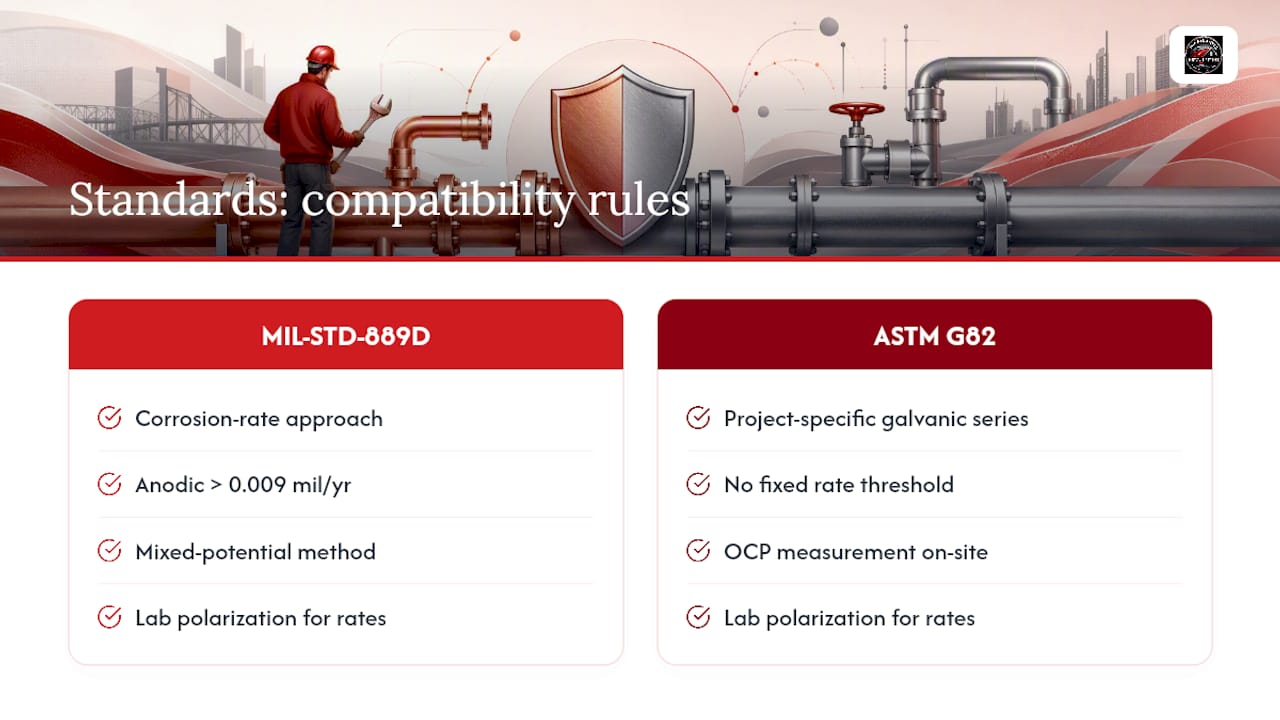
MIL-STD-889D takes a corrosion-rate approach rather than a pure voltage cutoff. For immersed conditions, a couple is classified as incompatible if the anodic member’s corrosion rate exceeds 0.009 mil per year. That’s a mixed-potential methodology, meaning it accounts for the actual polarization behavior of both metals under coupling, not just their static open-circuit potential difference. It reflects the same lesson from the mechanism section: two metals can look risky on paper and still test compatible once their real-world kinetics are measured.
ASTM G82 takes a complementary path, giving engineers a framework to build a galvanic series specific to their own project environment rather than relying on a generic textbook chart. On-site measurement of open-circuit potential (OCP) tells you the starting voltage gap between two metals in place, but it won’t tell you how fast corrosion will actually proceed. Polarization curves, generated in a lab under conditions matching the intended service environment, give a far more reliable read on expected corrosion rate. When a detail sits near a threshold, that lab data is worth the cost.
How Do You Actually Prevent Corrosion Between Different Metals?
Prevention starts with material selection and works down to installation detail. Get the big decision right, and the small stuff matters less. Get it wrong, and no coating or gasket fully compensates.
- Match potentials where possible. Choosing metals close together on the galvanic series, or the same metal throughout a detail, removes the driving force entirely.
- Manage area ratio deliberately. Where dissimilar contact is unavoidable, keep the anodic member’s exposed area as large as practical relative to the cathode, or isolate the smaller anodic part completely.
- Isolate electrically. Nonconductive washers, sleeves, and gaskets break the metallic path between fastener and panel. On high-strength bolted structural connections, though, compressible isolating materials can prevent the joint from developing proper pretension, so that detail needs engineering review against RCSC guidance before you swap in an insulating washer.
- Coat carefully, and coat both sides when you can. Protecting both members of a couple is more reliable than coating only the anode; a coating defect on an anode that’s otherwise unprotected can trigger severe, highly localized pitting right at the defect.
- Use sacrificial anodes where corrosion is unavoidable. Zinc, magnesium, and aluminum alloy anodes are engineered to corrode preferentially, protecting buried, submerged, or otherwise unreachable cathodic components.
- Seal and drain. Sealants at dissimilar joints and positive drainage that prevents standing water both remove the electrolyte the reaction depends on.
Pro Tip: If a detail can’t avoid dissimilar contact and can’t be fully isolated, oversize the anodic member instead. A bigger anode with the same current spread over more metal simply lasts longer, even without perfect isolation.
How Should You Inspect for and Monitor Galvanic Damage?
Start with the visual basics: localized pitting, rust streaking below a joint, chalky or powdery deposits near copper details, and fastener heads that look thinner or looser than their neighbors. Any of those at a dissimilar metal junction warrants a closer look, not a note for next year’s inspection.
For instrumented checks, OCP measurement with a reference electrode gives you the voltage gap in place, useful for screening but not for predicting rate. Coupon testing or current monitoring across a known couple gives a real corrosion rate over time. Ultrasonic thickness checks on suspect fasteners or flashing catch metal loss before it becomes a leak.
In coastal, industrial, or high-humidity exposures, inspect dissimilar joints at least annually, and always after a major storm or extended wet period. Repair or isolate a joint the moment you see active pitting or measurable thinning. Full replacement only makes sense once isolation is no longer physically possible.
Applying This to Standing Seam Roof Assemblies
Fastener choice is where most galvanic problems on a metal roof actually start, since a small fastener against a large panel field is exactly the area mismatch that concentrates corrosion current. On 1" mechanical lock and 1.5" snap lock standing seam systems, matching fastener material to panel material, or specifying nonconductive isolation where that’s not possible, is a basic spec decision worth getting right the first time.
- Custom cut-length panels and on-site roll forming reduce the number of field seams and exposed mating surfaces where mismatched metals could end up in contact.
- Copper flashing details need particular attention where runoff drains onto steel panel fields, a pairing worth reviewing on any copper roofing and flashing transition.
- Sealant and drainage detailing at trim and flashing junctions removes the standing moisture that turns a marginal couple into an active one.
- Panel gauge choice, whether 24-gauge or 26-gauge, affects how much corrosion allowance a detail has before thinning becomes a structural concern.
Three Rules That Keep Galvanic Surprises off Your Punch List
Match materials first. It’s cheaper to spec compatible metals up front than to isolate a mismatch after the fact. Second, treat every small anodic part, screws especially, as the weak point in any assembly and isolate it deliberately rather than hoping the area ratio works in your favor. Third, control moisture at the joint; no electrolyte means no circuit, regardless of what the galvanic series says.
Escalate to lab testing or a corrosion specialist when a detail sits near the 200 mV threshold in an aggressive environment, or when the assembly is structural and isolation materials might compromise bolt pretension. Standards like MIL-STD-889D and ASTM G82 set a reasonable floor, not a ceiling. Document the material pairing decision on every project where dissimilar metals meet. It’s a five-minute note now versus a callback later.
— Matt Catino
Sources
- What is galvanic corrosion? Principles, impacts and prevention for engineers
- Dissimilar metals in contact: design considerations
- Corrosion Guide No.5: Bimetallic corrosion (NPL)