High-Temp Underlayment for Metal Roofs: A Contractor's Guide
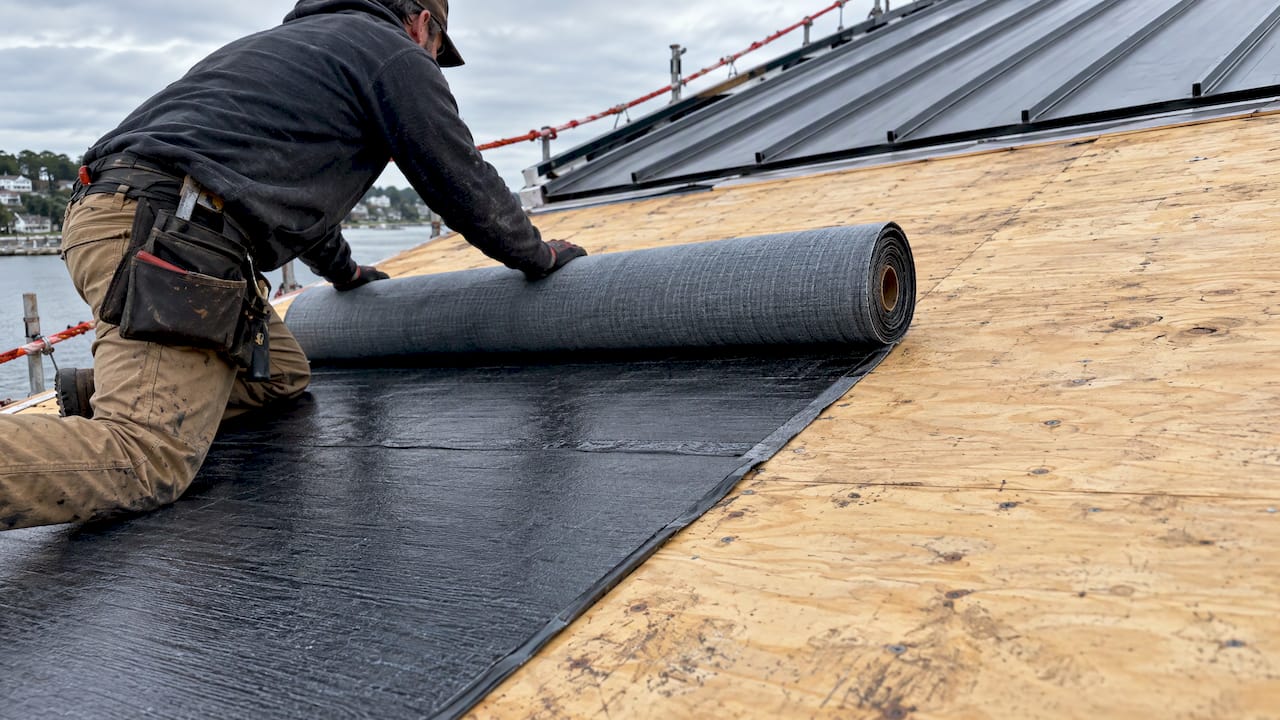
What high-temp underlayment does under a metal roof, which temperature rating to specify, how it compares to felt and synthetic, and how to install it.
High-temp underlayment is a self-adhered or specially formulated membrane rated to survive the heat that builds up between a metal roof panel and the deck. For most standing seam jobs, specify a product rated at least 225°F, and ideally 250°F to 265°F, and confirm the number against the panel manufacturer’s instructions before you order. Ordinary felt and standard ice and water shield are not built for that environment.
This guide covers what the product is, which rating to look for, how it compares with felt and synthetic sheet, where the code comes in, and how to install it so it does its job for the life of the roof.
TL;DR
- Metal roofs trap heat below the panels. Underlayment under metal should be rated for that environment, not just for shingles.
- A rating of at least 225°F keeps the mastic from softening, and 250°F to 265°F suits most applications, according to industry trade press.
- Felt is the cheapest option but wrinkles, tears at fasteners and softens against hot panels. High-temp self-adhered membrane seals around fasteners and handles low slopes.
- Underlayment must carry the right ASTM label and follow the panel manufacturer’s instructions, which control on a warranted roof.
- Install flat, within the manufacturer’s temperature window, and give the roof proper ventilation.
Table of Contents
- What high-temp underlayment is and why metal roofs need it
- What temperature rating to specify
- Felt, synthetic sheet or high-temp self-adhered?
- Code and labeling: what the inspector looks for
- Compatibility: check before you stick
- Installing high-temp underlayment under standing seam
- Matt Catino’s perspective
- How the cost question plays out
- Order the roof package together
- FAQ
- Sources
What high-temp underlayment is and why metal roofs need it
Underlayment is a membrane installed directly on the roof deck, under the metal panels. It is a second barrier against rain, snow and wind, and a well-designed, well-installed one keeps moisture from getting through the deck into the building.
What sets metal apart is heat. The same trade publication notes that a typical metal roofing system is a high-temperature environment, and that the heat captured below the cladding can be much higher than under other roof assemblies. An underlayment for metal should therefore be approved to perform in those conditions so waterproofing holds over the long term.
A dark panel in full sun shows the problem clearly. A field guide from a roofing materials company points out that the asphalt compound in an ordinary ice and water shield can soften, flow and lose its grip at the temperatures under a dark metal roof. The fix is a high-temperature self-adhered membrane made for that use. A manufacturer of these membranes also says that thermal expansion and contraction of a metal roof can destroy common synthetic and felt underlayments.
The job of the membrane is to be the backup. The panels shed most of the water, but wind-driven rain, ice dams and condensation will find a path eventually, and the underlayment is what stands between that water and the deck.
What temperature rating to specify
There is no single universal number, but the published guidance clusters tightly.
- Trade press recommends a minimum of 225°F for self-adhered underlayment under metal, so the mastic does not soften and seep out, with 250°F to 265°F suitable for most applications.
- One major shingle and underlayment manufacturer lists heat resistance up to 240°F for its metal roof underlayments.
- Another manufacturer’s installation guide describes a self-adhering high-temp product engineered for 40°F to 250°F.
- A third product is designed to resist heat up to 265°F and is made to meet ASTM D1970 and ICC AC 48 performance requirements.
The practical read: 240°F is a sensible floor for a standing seam job, and 250°F to 265°F gives margin for dark colors, low-slope sections and hot climates. Trade press also advises checking with the manufacturer for the rating a specific metal roof needs, which brings us to the rule that overrides everything else.
The panel manufacturer’s instruction controls
The covering manufacturer’s instructions state the temperature rating the underlayment has to meet, and on a warranted roof, that is the number that controls. Before you order, pull the panel installation instructions and the warranty terms, write the required rating on the material list, and make sure the underlayment you pick is rated at or above it. That one step avoids most callbacks and most warranty arguments.
Felt, synthetic sheet or high-temp self-adhered?
Three families of underlayment show up under metal. Industry guidance from a steel industry education group describes them this way:
| Type | Strengths | Weak points under metal |
|---|---|---|
| Asphalt-saturated felt | Lowest cost | Wrinkles when wet, poor tear strength at fasteners, softens against hot panels |
| Synthetic sheet | Dimensionally stable when wet, high tear strength | Does not seal around fasteners |
| High-temp self-adhered membrane | Fully adheres to the deck, seals around fasteners, handles low slope | Higher material cost, needs a ventilated roof |
The comparison above follows guidance from the steel industry’s roofing underlayment overview.
Why felt struggles under metal
Trade press states that asphalt felt is not considered high-temp, that in extreme heat the asphalt can leak out at the eaves and fail, and that felt gives little resistance to air and moisture vapor movement. On a steep, simple roof with mild exposure, some codes still accept it, as covered below. On a dark, high-value standing seam roof, most crews choose something better.
Where self-adhered earns its place
High-temp self-adhered membrane is the strongest fit in these spots:
- Eaves, valleys, dormers and other areas prone to ice dams and wind-driven rain.
- Low-slope sections, where water moves slowly and a fastener hole matters more.
- Roofs with dark or high-heat panel finishes. If you are helping a customer choose, our standing seam metal roof colors page is a useful starting point for thinking about panel heat.
- Full-deck coverage when the project calls for the most protection.
A metal roofing supplier operations manager quoted in trade press says self-adhered underlayments give the best protection against ice dams, wind-driven rain and moisture, and that the key is ventilating the roof properly, because some of these membranes act as vapor barriers that do not let air pass through.
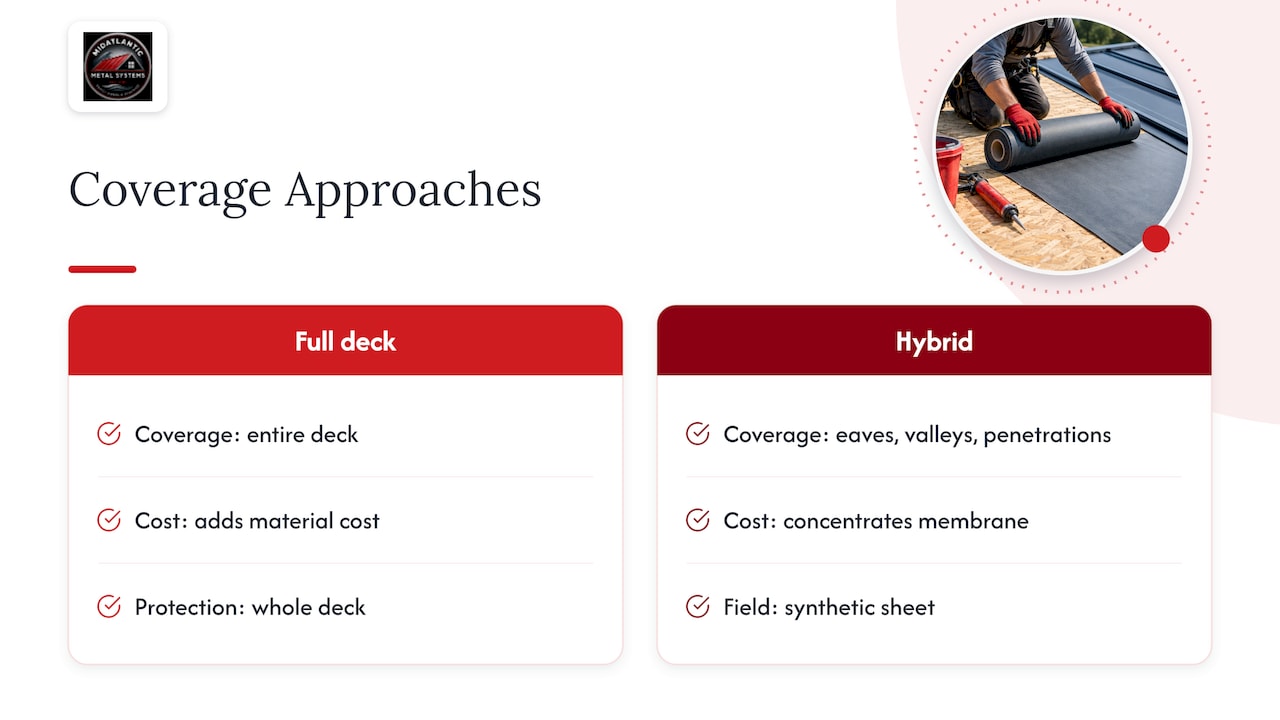
There are two common ways to use it: full-deck, or only at vulnerable areas with synthetic sheet in the field. Some synthetic field products are used over the rest of the deck on budget-sensitive jobs, with a high-temp self-adhered layer at eaves, valleys and penetrations. Which approach you choose depends on slope, climate, panel color and what the panel manufacturer requires.
Code and labeling: what the inspector looks for
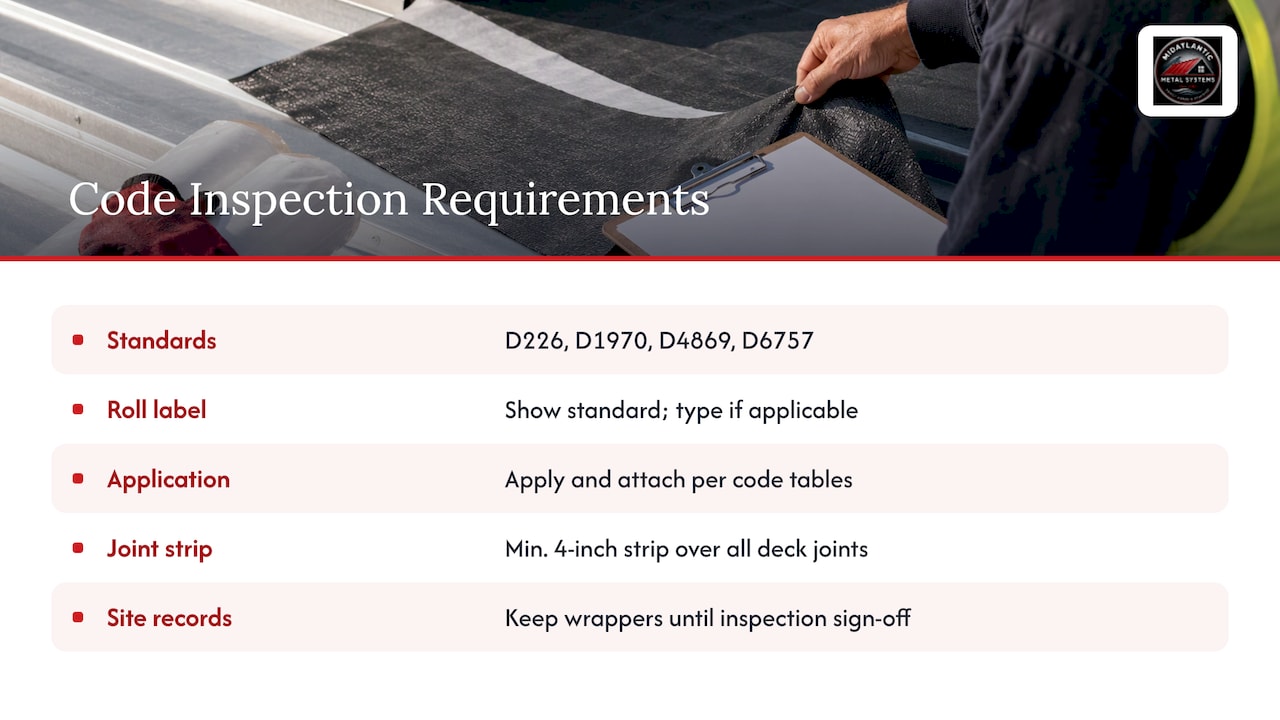
Underlayment is a code item as well as a performance item. Under the model codes, underlayment materials that must comply with ASTM D226, D1970, D4869 and D6757 must carry a label showing the standard designation and, where applicable, the type classification, and they must be applied and attached according to the code tables. Keep the roll labels or wrappers on site until the inspection is signed off.
Self-adhering polymer-modified bitumen membranes are typically tested to ASTM D1970. Jurisdictions adopting the model code also allow a strip of that membrane as a joint treatment: guidance on the 2021 codes from a state planning commission describes a minimum 4-inch-wide strip of self-adhering membrane labeled to ASTM D1970 over all roof-deck joints, with approved underlayment applied over the entire roof.
Local amendments vary across Virginia, Maryland, DC, Pennsylvania and West Virginia, so confirm the adopted code edition with the local building department. For slope limits and other metal roofing checks, our IBC metal roofing requirements article walks through what contractors should verify. If the job is a re-roof, read what contractors must check for metal over shingles before deciding what goes between the old layer and the new panels, and see code-ready metal roof over insulation when insulation sits above the deck.
Compatibility: check before you stick
High-temp membranes use aggressive adhesives, and that creates compatibility rules.
- Adjacent materials. One manufacturer’s installation guide cautions against installing its asphalt-adhesive membrane on, at or near PVC or other materials that are not compatible with asphalt. Check flashings, pipe boots and membranes at transitions.
- Panel finish and warranty. Read the panel instructions for the required rating and any restrictions on the underlayment type.
- Deck condition. Clean, dry, smooth decking helps the membrane bond. Fix protruding fasteners and debris first.
- Primer or deck requirements. Follow the membrane’s data sheet for the deck type you have.
When the panel instructions and the underlayment data sheet disagree, stop and call both manufacturers. A written answer is worth more than a guess.
Installing high-temp underlayment under standing seam
The steps below follow manufacturer installation guidance. Always follow the instructions for the specific product you buy.
- Prepare the deck. Sweep, dry and inspect the deck. Set up drip edge according to the roof plan.
- Check the weather window. One manufacturer’s high-temp product should go down when air temperature is above 40°F and rising but below 100°F for best adhesion, and above 100°F direct sun can make the release backing hard to remove. In cold weather, our winter metal roof installation guide covers how crews adapt.
- Start at the eave. Work from low to high so each course laps over the one below and sheds water.
- Peel and press. Another manufacturer’s instructions say to remove the split release film completely, lay the adhesive side back into place, and apply heavy hand pressure.
- Keep it flat. The same guide requires the membrane to be installed flat, with no wrinkles or buckles. Wrinkles telegraph under panels and can hold water.
- Treat valleys, penetrations and transitions first. Layer the membrane so every lap sheds water, and keep sealed details clean and tidy.
- Panel it promptly. Trade press notes that UV exposure ratings matter for jobsite scheduling, so check how long the product can stay uncovered and plan panel delivery to match.
That last point is where scheduling matters most. Underlayment left exposed through weeks of weather is underlayment you may need to replace.
Details that keep water out
Most leaks on a good roof start at details, not in the field. The same logic that applies to flashing a wall penetration applies at roof edges and transitions, and a good primer on deck ledger flashing details shows how overlap order and sealed laps keep water moving out and away. On a metal roof, the trim and flashing package is where that thinking turns into material.
Panel movement and slip sheets
Some underlayments grip panel undersides under heat and can cause binding or noise as the panels expand and contract. When a project calls for a separation layer between the membrane and the panel, see our article on slip sheets under metal roofs for when and why crews add one.
Matt Catino’s perspective
Our view from the supply side
We supply standing seam panels, trim and flashing to contractors across Virginia, Maryland, Washington DC, Pennsylvania and West Virginia, so we see the same pattern on job after job: the underlayment decision gets made late, and it gets made on price. We think it should be made early, from the panel instructions.
Our panels are 24-gauge and 26-gauge steel, in 1-inch mechanical lock and 1.5-inch snap lock profiles. Those are architectural roofs, often in dark colors, often on custom homes and commercial buildings where a leak is expensive and visible. On that kind of roof, we believe a high-temperature membrane rated for the heat under metal is the right starting point, and we encourage contractors to put the required rating on the takeoff next to the panel quantities.
The other piece is timing. Because we cut panels to length and deliver them to the job site, the roof can go on soon after the underlayment is down. That helps keep the membrane covered quickly, and it keeps crews from working around stacked material. Our trim and flashing packages are coordinated with the panels so the details at eaves, rakes, valleys and walls are ready when the deck is.
Our advice is simple: read the panel instructions, pick the membrane to match, confirm compatibility at every transition, and order panels to land when the crew is ready to install.
Matt Catino
How the cost question plays out
High-temp self-adhered membrane costs more per square than felt or synthetic sheet. Published pricing from retail sources changes often, so use current quotes from your distributor rather than a number from an article. What matters in the estimate is the trade-off: full-deck self-adhered adds material cost and protects the whole deck, while a hybrid approach concentrates the expensive membrane where leaks are most likely.
Felt does have a place in code. The 2024 International Residential Code table for metal panels on solid sheathing lists ASTM D226 Type I or II felt, and in wind-design areas adds ASTM D1970 and D8257 products, as summarized in an underlayment pricing guide. Meeting minimum code and meeting the panel manufacturer’s warranty terms are not always the same bar, so the stricter of the two is the one to build to.
Order the roof package together
Underlayment, panels, trim and flashing all have to be ready at the same time for a roof to go on cleanly. We cut standing seam panels to the lengths your plan calls for through cut-and-drop delivery, and we pair them with a trim and flashing package so edges and transitions are covered. Where long runs or tight access make delivery hard, on-site roll forming is an option.
Send us your plans and we will help with the takeoff. See our 1-inch mechanical lock and 1.5-inch snap lock panels, check panel specs, or go to contractor supply to start an order.
FAQ
Is regular ice and water shield OK under a metal roof?
Usually not. The asphalt compound in a standard product can soften and flow at the temperatures under a dark metal roof, which is why a high-temperature version is recommended. Check the panel manufacturer’s required rating and use a membrane that meets it.
What temperature rating should I look for?
Trade press says at least 225°F so the mastic does not soften, and 250°F to 265°F for most applications. Product ratings run from about 240°F to 265°F. Always match or beat the rating in the panel manufacturer’s instructions.
Do I need self-adhered membrane across the whole deck?
Not always. Many crews use high-temp self-adhered at eaves, valleys, penetrations and low-slope areas, and synthetic sheet in the field. Full-deck coverage gives the most protection against leaks at fasteners. Follow the panel instructions, local code and your customer’s budget.
Can felt go under standing seam panels?
Some codes allow it on adequate slopes, but felt wrinkles when wet, tears at fasteners and softens against hot panels. For architectural standing seam, most contractors prefer a synthetic or high-temp self-adhered product. Confirm with the panel manufacturer and the local building department.
Does the roof need ventilation with self-adhered underlayment?
Yes, plan for it. Some self-adhered membranes act as vapor barriers that do not let air pass through, so a properly ventilated roof assembly is essential. Work out ventilation with the roof designer before the membrane goes down.
Sources
- Achieving Moisture Protection with Roof Underlayments, Metal Construction News
- Comparing Roof Underlayments, Metal Construction News
- High Temperature Underlayment for Metal Roofing
- Roofing underlayment types: felt, synthetic, and self-adhered
- What’s Beneath Your Roof Matters: Understanding Roofing Underlayment, Build Using Steel
- Titanium Metal Roof Underlayments, Owens Corning
- Secure Start HT installation guide
- Weather-Armor HT2 High Temperature Roof Underlayment
- RhinoRoof High-Temp installation instructions, Owens Corning
- Requirements for Roof Coverings, UpCodes
- Roof Covering Replacement, IBC and IRC 2021 guidance
- Metal Roof Underlayment: High-Temp, Synthetic, Felt
- Deck Ledger Flashing: How to Keep Water Out of Your Wall